
Skip to content
  • Contact
  • Support
  • Account logins
  • Pay my bill
    • Pay my electric bill
    • Pay my internet bill
HES
  • Electric
    • Electric services
    • Outage map
    • Start
    • Stop
    • Transfer
    • Energy efficiency
  • Internet
    • For my home
    • For my business
  • Phone
    • For my home
    • For my business
  • Programs
  • About us
  • Sign up
    • Electric
    • Internet
HES
  • Electric
    • Electric services
    • Outage map
    • Start
    • Stop
    • Transfer
    • Energy efficiency
  • Internet
    • For my home
    • For my business
  • Phone
    • For my home
    • For my business
  • Programs
  • About us
  • Electric sign up
  • Internet sign up
  • Contact
  • Support
  • Account login
  • Pay my electric bill
  • Pay my internet bill
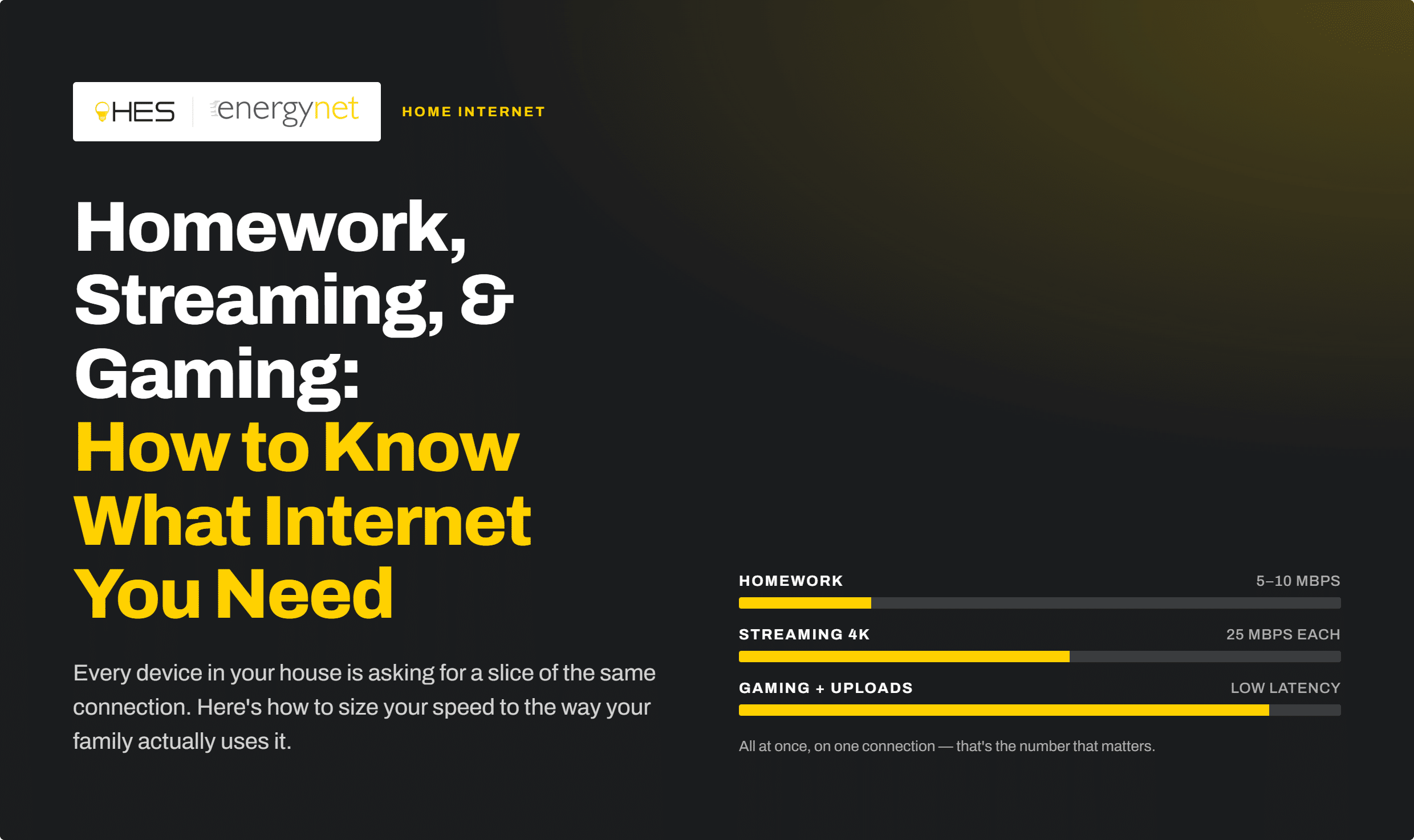
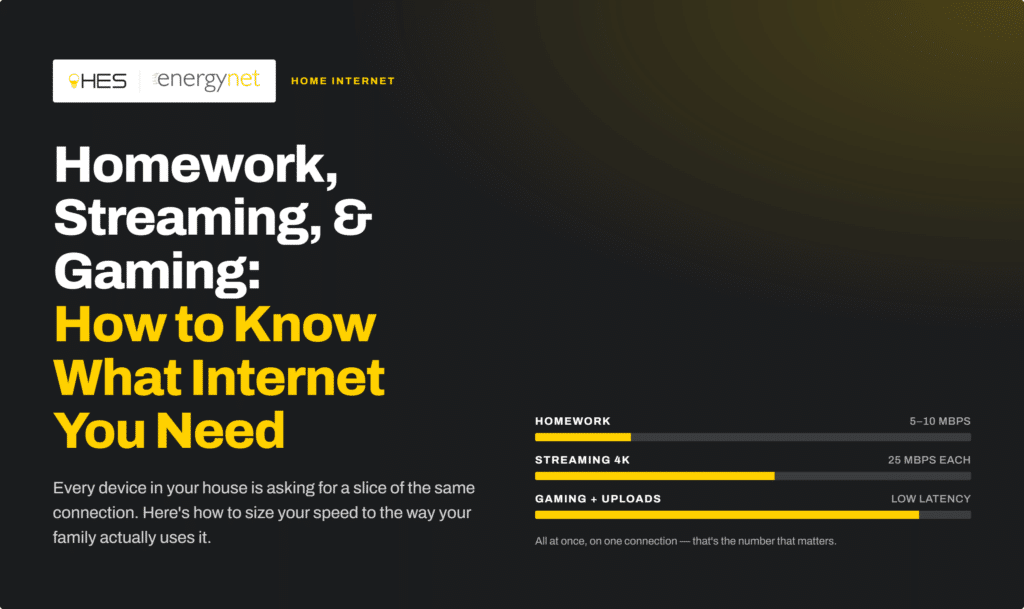
  • Homework, Streaming & Gaming: How to Know What Internet You Need

    Homework, Streaming & Gaming: How to Know What Internet You Need
    fiber, internet, HES, energynet
    Homework, Streaming & Gaming: How to Know What Internet You Need

    Your household runs on the internet more than it probably did even a couple of years ago. Homework is done through a school portal. Family movie night is a stream, not a DVD. Someone’s mid-match in an online game while someone else is on a video call in the next room. All of that is happening over the same connection, at the same time, and if your internet speed doesn’t match what your home actually asks of it, everyone feels it.

    The tricky part is that “internet speed” isn’t one-size-fits-all. What a single person streaming shows in the evening needs looks nothing like what a family of five juggling school, work, gaming, and smart home devices needs. Here’s how to think about it and how to stop guessing.

    Why “More Devices” Isn’t the Only Factor

    It’s tempting to think bandwidth needs come down to a simple device count. More devices, more speed, right? That’s part of it — but how those devices are being used matters just as much as how many there are.

    A household with ten devices that are mostly idle (a few smart bulbs, a thermostat, a couple of phones checking email) needs far less bandwidth than a household with four devices all actively streaming, gaming, and video calling at once.

    The real question isn’t “how many things are connected?” — it’s “how many things are actively pulling data at the same time, and how demanding is each one?”

    What Different Activities Actually Use

    Here’s a rough sense of how common household activities stack up:

    • Browsing, email, social media — Light usage. Barely registers against your total bandwidth.
    • Streaming video — Moderate to heavy, and it scales with quality. A single 4K stream can use significantly more bandwidth than a standard HD stream, and running two or three 4K streams in different rooms adds up fast.
    • Online gaming — Doesn’t require huge bandwidth on its own, but it’s extremely sensitive to latency (lag). Gaming alongside heavy streaming or large downloads on the same network is often what causes that frustrating lag mid-match.
    • Video calls (school, work, or personal) — Moderate usage, but needs a stable, consistent connection — this is one area where a shaky connection is very noticeable, very fast.
    • Large downloads and updates — Game installs, software updates, and cloud backups can spike usage significantly, even if just for a short window.
    • Smart home devices — Individually light, but they add up in a home with many of them running continuously.

    The households that feel the most friction are usually the ones stacking several of these at once during the same few hours, right around homework time, dinner, and evening streaming.

    The Three Things That Actually Determine Your Ideal Speed

    When you strip it down, the right internet speed for your home comes down to three things:

    1. How you use the internet. Light browsing and email is a very different household than one with multiple gamers, streamers, and remote workers.
    2. How many devices are connected and connected at once. Not just phones and laptops, but smart TVs, tablets, consoles, doorbells, thermostats, and everything else quietly online in the background.
    3. The size of your living space. A larger home means your WiFi signal has more distance and more walls to travel through, which affects how consistently that speed actually reaches every room.

    Get those three right, and choosing a speed stops being a guessing game.

    Skip the Guesswork: Try Our Speed Recommendation Tool

    Rather than estimating or defaulting to “just get the fastest plan,” HES EnergyNet has a quick tool on our website built for exactly this. Answer three simple questions:

    • How you use the internet
    • How many devices connect in your home
    • The size of your living space

    …and it recommends the internet speed that actually fits your household — not more than you need, and not less than you’ll be frustrated by. It takes less time than reading this article, and it takes the guesswork out of picking a plan.

    Speed Is Only Half the Story — Security Is the Other Half

    A fast connection doesn’t mean much if it isn’t a safe one. With more devices connected — including things like smart cameras, thermostats, and voice assistants that quietly stay online around the clock — your home network is a bigger target than it used to be.

    That’s why ProtectIQ is included with every HES EnergyNet speed tier, at no extra cost. ProtectIQ works in the background to help guard your home network against threats, giving you:

    • Network-level threat protection that helps block malicious sites and attacks before they reach your devices
    • Protection that covers every connected device on your network — not just the ones with antivirus software installed
    • Peace of mind for smart home and IoT devices, which are often the least secure devices in a home but are just as connected as everything else

    You don’t have to choose between a fast household and a protected one. With HES energynet, you get both, automatically.

    The Bottom Line

    The right internet speed isn’t about buying the biggest number on the price list — it’s about matching your plan to how your household actually lives online: homework during the week, movie nights on the weekend, gaming with friends, and everything running smoothly at the same time without anyone shouting “the WiFi is lagging!” from the other room.

    Not sure where your household lands? Try our speed recommendation tool — three quick questions, and you’ll know exactly what speed fits your home. And with ProtectIQ included at every tier, you’ll have the security to match.

    Brandon Tubbs

    September 17, 2026
    News
    energynet, fiber, fiber internet, fiber to the home, hopkinsville, internet, streaming
  • The Parent’s Guide to Managing Screen Time During the School Year

    Thumbnail Placeholder
    parent's guide to managing screen time during the school year

    The Parent’s Guide to Managing Screen Time During the School Year

    Between homework portals, group chats, streaming shows, and gaming with friends, screens are woven into nearly every part of your kid’s day. That’s not automatically a bad thing, but as the school year ramps up, so does the competition between screens and everything else: sleep, focus, chores, and face-to-face time with family.

    The good news? You don’t need to become the “no screens” household to get things back in balance. With a few household habits and the right tools, you can help your kids build a healthier relationship with technology, without a daily battle over the tablet.

    Why Screen Time Habits Matter More During the School Year

    Summer schedules are loose. School schedules aren’t. Once homework, extracurriculars, and early bedtimes are back on the calendar, screen time that felt harmless in July can start crowding out sleep, studying, and downtime in September.

    A few things tend to shift once school starts:

    • Bedtime creep. Late-night scrolling or gaming pushes back sleep, and tired kids struggle more the next day in class.
    • Homework competing with notifications. Group chats, games, and social apps are just a tap away from the homework tab.
    • Less unstructured “boredom” time. Downtime that used to go toward reading, outside play, or hobbies quietly gets absorbed by a screen.

    None of this means technology is the enemy. It just means the school year is a good time to reset expectations as a family.

    Start With a Family Internet Habits Conversation

    Rules that get handed down without explanation rarely stick. Kids (especially older ones) respond much better when they’re part of building the plan. Consider sitting down together and talking through:

    • When screens are “on” and “off.” Common examples: no devices during meals, homework time, or the hour before bed.
    • Where screens live. Charging devices in a common area overnight, rather than the bedroom, is one of the simplest ways to protect sleep.
    • What “screen time” actually includes. Homework research, video calls with grandparents, and creative projects don’t need to count the same as passive scrolling.
    • What happens when the plan slips. Decide consequences together so they feel fair, not arbitrary.

    Write the plan down and put it somewhere visible, the fridge, a shared note, wherever your family actually looks. A habit is much easier to keep when everyone agreed to it in the first place.

    Use Parental Controls to Back Up the Conversation

    Conversations set expectations. Parental controls make those expectations actually happen, even when you’re not standing over a shoulder to enforce them.

    That’s where ExperienceIQ, included with HES EnergyNet fiber internet, comes in. It gives you visibility and control over what’s happening on your home network, right from your phone, including the ability to:

    • Set time limits by device or by person. Give homework time a clear, phone-free window without hovering over anyone.
    • Pause the internet instantly. Perfect for calling everyone to dinner or shutting things down at bedtime, no more hunting for chargers or routers.
    • Filter content by age group. Keep browsing appropriate for younger kids without blocking what older kids and adults need.
    • See what’s connected and how it’s being used. A quick check-in tool, not a surveillance system, it helps you spot patterns, like a device that’s active well past bedtime.

    Think of ExperienceIQ as the guardrails, not the whole plan. It’s there to support the family agreement you’ve already made, not replace the conversation altogether.

    Building Healthy Tech Habits That Last

    Managing screen time isn’t just about restriction, it’s about making sure screens have a healthy place in your family’s routine, rather than the default filler for every quiet moment. A few habits worth building:

    Model it yourself. Kids notice when the “put the phone away” rule only applies to them. Try phone-free dinners or a family “devices down” hour that includes the adults too.

    Protect the last hour before bed. Blue light and stimulating content make it harder to wind down. Swap the last hour of screen time for reading, a board game, or just talking about the day.

    Make “screen-free” the easy choice sometimes, too. Keep a few go-to alternatives within easy reach, a deck of cards, art supplies, a basketball by the door, so boredom doesn’t default to a device out of habit.

    Talk about what they’re watching and playing, not just how long. Not all screen time is equal. A video call with a cousin, a coding app, or a documentary is a very different experience than an hour of algorithm-driven scrolling. Ask questions and stay curious about what your kids enjoy online.

    Revisit the plan often. What works for a 4th grader looks nothing like what works for a high schooler, and needs change as the school year goes on. Check in as a family every few weeks and adjust.

    Balance, Not Perfection

    There’s no perfect screen time number that works for every family, and chasing one usually just creates more stress than it solves. The goal isn’t to eliminate technology; it’s to make sure it’s not quietly running the household.

    With an honest family conversation, a few consistent habits, and tools like ExperienceIQ working in the background, you can keep this school year running smoothly, homework done, bedtimes protected, and a little more face time around the dinner table.

    Interested in HES EnergyNet fiber internet with ExperienceIQ? Check the availability in your area today by clicking here: https://goenergynet.com/home

    Brandon Tubbs

    August 26, 2026
    News
    fiber internet, home internet, internet, managing screen time
1 2 3 … 8
Next Page

Electric

  • Start Service
  • Stop Service
  • Transfer Service
  • Pay as You Go Program
  • Energy Efficiency
  • New Construction
  • Landlord Requests
  • Your Rate Explained
  • Security Lights

Internet

  • Home Internet
  • Business Internet
  • Lifeline
  • Landlord Release

Phone

  • Home Phone
  • Business Phone

Company

  • Contact
  • About Us
  • Programs
  • Support
  • Account Logins
  • Hometown Grid
  • Legal

Sign up for…

Electric service
Internet service

Billing

Pay my Electric bill
Pay my Internet bill

Copyright 

2026

 Site design by Pivot.